
Introduction
Chemical processing plants present some of the most challenging environments for instrumentation. Sensors must provide accurate data to control complex, often exothermic reactions while surviving exposure to highly corrosive media, high pressures, and potentially explosive atmospheres.
Instrument reliability is not merely a matter of process efficiency; it is fundamentally a matter of safety. A failed sensor or compromised thermowell can lead to a loss of containment or a runaway reaction.
Process Context
Temperature measurement points are ubiquitous across a chemical facility: inside batch and continuous reactors, along transfer pipelines, within distillation columns, and throughout heat exchanger networks.
The primary challenge is rarely the temperature range itself—which often falls within the comfortable operating band of standard RTDs or base-metal thermocouples—but rather the aggressive nature of the chemical media and the strict requirements for hazardous area certification.
Selection Guidance
The selection of the thermowell is often more critical than the sensor element. Standard stainless steel (316L) is sufficient for many applications, but aggressive media (e.g., strong acids, chlorides) may dictate the use of exotic alloys like Hastelloy, Monel, Inconel, or Titanium.
For extreme corrosion resistance at lower temperatures, thermowells lined or coated with PTFE, PFA, or Tantalum are frequently utilized. The internal sensor is typically a spring-loaded Pt100 RTD for standard chemical processes, or a Type K thermocouple if temperatures exceed 500°C.
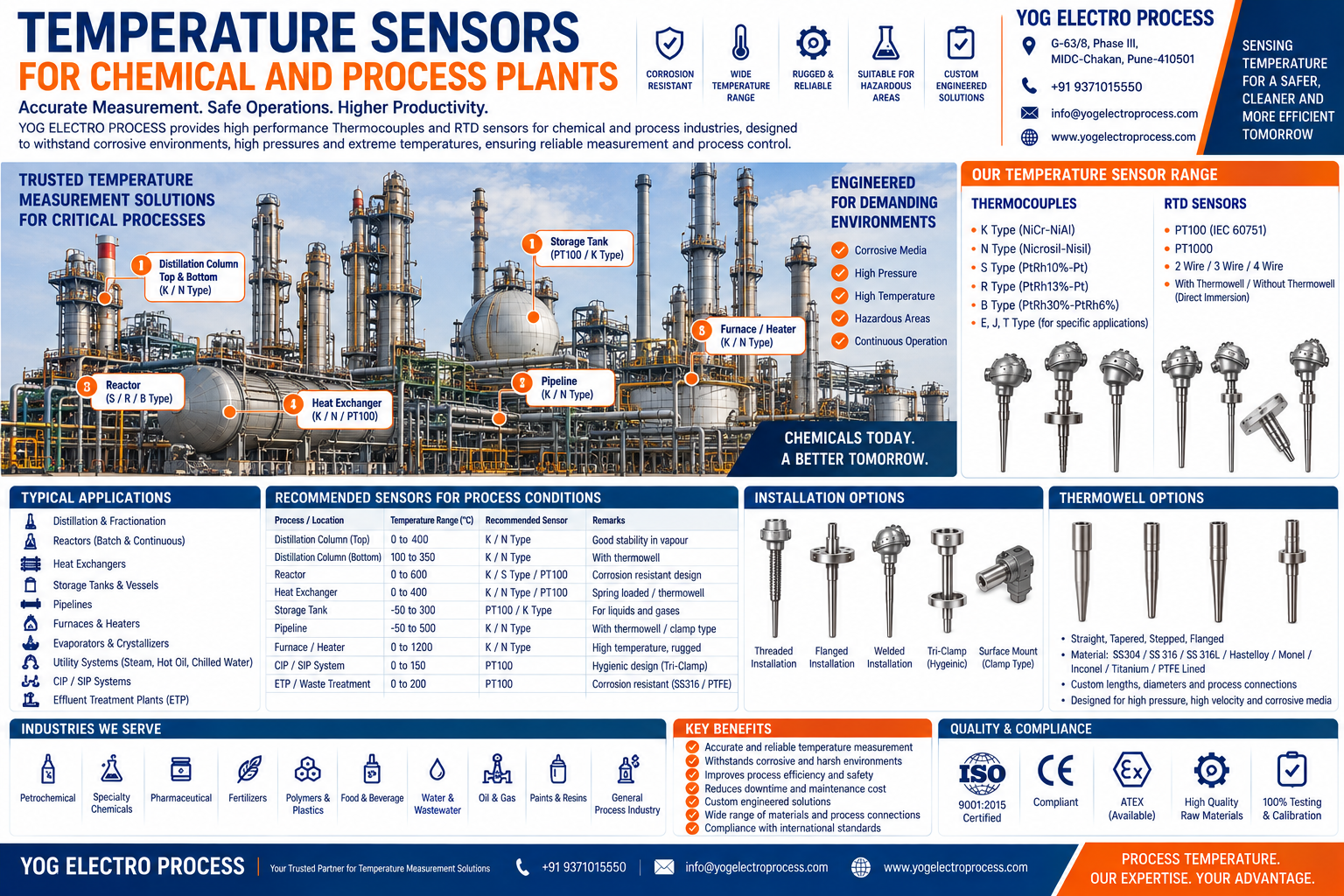
Recommended Sensors
Exotic Alloy Thermowell Assemblies
Solid-drilled thermowells machined from Hastelloy, Monel, or Inconel for use in highly corrosive reactor environments.
PTFE/PFA Lined Thermowells
Stainless steel thermowells coated or lined with fluoropolymers for exceptional resistance to strong acids and bases.
Hazardous Area (Ex-d / Ex-i) Sensors
Sensor assemblies featuring certified explosion-proof connection heads or intrinsically safe designs for classified zones.
Installation Considerations
In pipelines, thermowells must be inserted to a depth sufficient to position the sensing element in the active flow (typically the center third of the pipe) to avoid measuring the cooler boundary layer near the pipe wall.
When installing in hazardous areas, all cable glands, connection heads, and thermowell seals must adhere strictly to the site's electrical classification requirements. Routine inspection of the thermowell for corrosion or erosion is recommended.
Key Benefits
- Maintains precise reaction kinetics, maximizing yield and minimizing unwanted byproducts.
- Ensures personnel and plant safety through reliable detection of temperature excursions.
- Prevents loss of containment by utilizing properly specified, corrosion-resistant thermowells.
- Simplifies integration with DCS using standardized HART or Foundation Fieldbus transmitters.
Specifications
| Parameter | Typical Specification |
|---|---|
| Sensing Element | Class A Pt100 RTD or Type K Thermocouple |
| Thermowell Materials | 316L SS, Hastelloy C276, Monel 400, Titanium, PTFE-lined |
| Hazardous Certification | ATEX / IECEx Ex-d (Flameproof) or Ex-i (Intrinsically Safe) heads |
| Process Connection | Flanged (ASME/EN) to ensure secure sealing in high-pressure vessels |
| Transmitter Output | Head-mounted 4-20mA with HART protocol is standard |
Frequently Asked Questions
When should I choose Hastelloy over 316L Stainless Steel?
Hastelloy (such as C276) is typically specified when dealing with severe corrosives where 316L is susceptible to rapid pitting or stress corrosion cracking, such as environments containing high concentrations of chlorides, sulfuric acid, or hydrochloric acid.
What is the difference between Ex-d and Ex-i temperature sensors?
Ex-d (Flameproof/Explosion-proof) relies on a robust enclosure to contain any internal explosion, while Ex-i (Intrinsically Safe) limits the electrical energy delivered to the sensor to a level below that required to ignite the atmosphere.
Why use a lined thermowell instead of a solid exotic alloy?
PTFE or PFA lined thermowells often provide superior chemical resistance to broad-spectrum acids at a lower cost than solid exotic alloys, provided the operating temperature remains below the polymer's melting point (typically around 200°C).
Can a thermowell cause a measurement delay?
Yes, the mass of a thermowell introduces a thermal lag. This can be minimized by selecting a stepped or tapered thermowell design, ensuring a tight fit for the sensor, and utilizing spring-loaded elements.
References
Need an engineered solution?
Speak with our technical specialists to design a sensor assembly perfectly matched to your application requirements.
Contact Engineering Team