
Introduction
Industrial ovens and dryers are critical to finishing operations across countless industries, from curing powder coatings and drying textiles to annealing metals and baking food products. The success of these operations relies entirely on achieving and maintaining strict thermal uniformity throughout the workspace.
A localized cold spot can leave coatings uncured or products damp, while a hot spot can scorch materials or degrade physical properties. Accurate temperature sensing is the only way to verify that the specified heating profile is applied consistently to the entire batch.
Process Context
The primary measurement challenge in ovens and dryers is the reliance on convective heat transfer. Unlike immersion sensors in liquids or solids, oven sensors measure moving air or gases. Air is a poor thermal conductor, meaning the sensor's physical mass and placement drastically affect its response time.
Furthermore, operators must distinguish between the 'air temperature' (the setpoint of the oven) and the 'product temperature' (the actual temperature of the mass being heated). In continuous conveyor dryers, profiling the different heating, holding, and cooling zones adds another layer of complexity.
Selection Guidance
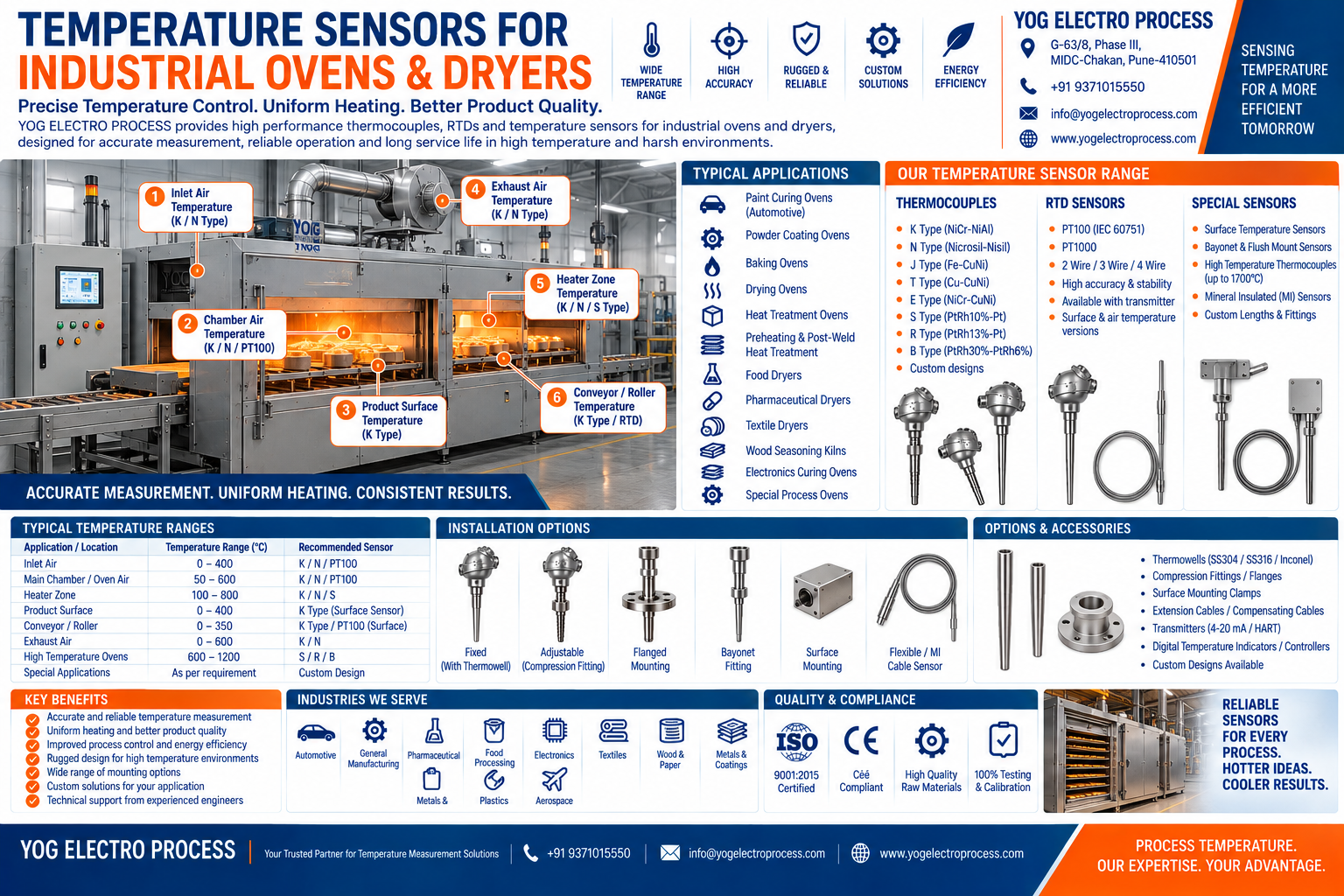
For general oven control, Pt100 RTDs or Type J/K thermocouples are standard. To measure air temperature accurately, the sensor must have a fast response time. This is achieved by minimizing the mass of the protection tube; thin-walled sheaths or exposed junctions (in clean, dry atmospheres) are often preferred.
When measuring product temperature, 'load sensors' are utilized. These are typically heavy-duty thermocouples physically attached to or embedded within a dummy product to mimic the thermal mass of the actual load, ensuring the core of the product has reached the required curing temperature.
Recommended Sensors
Fast-Response Air Sensors
Thin-walled, mineral-insulated thermocouples or RTDs designed to rapidly track fluctuations in the convective airstream.
Heavy-Duty Load Thermocouples
Rugged sensors designed to be attached directly to the product or a representative thermal mass to verify core curing temperatures.
Multi-Point Profiling Arrays
Custom assemblies featuring several measurement points along a single sheath, used to map thermal uniformity across large oven chambers.
Installation Considerations
Air sensors should be positioned directly in the active airflow, typically near the return duct to the heater box, to provide an accurate representation of the average chamber temperature. Placing a sensor in a stagnant corner or too close to the radiant heat of the burner will result in massive control errors.
Ensure that sensor lead wires passing through the oven wall are adequately protected. Use high-temperature insulation (like fiberglass or ceramic fiber) and route cables away from direct contact with heating elements or moving conveyor parts.
Key Benefits
- Guarantees product quality by ensuring full polymerization of coatings or complete moisture removal.
- Reduces energy consumption by preventing unnecessary overheating of the chamber.
- Enables compliance with stringent quality standards (like NADCAP or CQI-9) through verifiable thermal uniformity surveys (TUS).
- Minimizes cycle times by optimizing the heat-up and cool-down phases of batch operations.
Specifications
| Parameter | Typical Specification |
|---|---|
| Standard Curing/Drying Range | 50°C to 300°C (Pt100 RTD or Type J) |
| High-Temp Annealing Range | 300°C to 1000°C (Type K or N) |
| Air Sensor Construction | Thin-wall SS304/316 sheath, < 6mm diameter |
| Junction Style (Thermocouples) | Exposed (fastest) or Grounded (protected but fast) |
| Mounting Style | Adjustable compression fittings or flanged wall-mounts |
Frequently Asked Questions
Why is the oven controller showing a different temperature than my product?
The controller measures the air temperature. The product has thermal mass, meaning it takes time to absorb that heat. This thermal lag is normal, which is why 'load sensors' are used to verify the actual product temperature.
Should I use an RTD or a thermocouple for a drying oven?
For temperatures below 250°C, a Pt100 RTD is generally preferred due to its superior accuracy and stability. For higher temperature baking or annealing (above 300°C), Type K or N thermocouples are more durable.
What is an exposed junction thermocouple?
An exposed junction has the thermocouple wires protruding beyond the metal sheath, directly into the air. It provides the absolute fastest response time but is vulnerable to physical damage and corrosive gases. It should only be used in clean, dry environments.
How do I map the temperature uniformity of my oven?
A Thermal Uniformity Survey (TUS) involves placing multiple sensors (often 9 or more, depending on the standard) in a geometric grid throughout the empty oven chamber to identify hot and cold spots during a normal thermal cycle.
References
Need an engineered solution?
Speak with our technical specialists to design a sensor assembly perfectly matched to your application requirements.
Contact Engineering Team